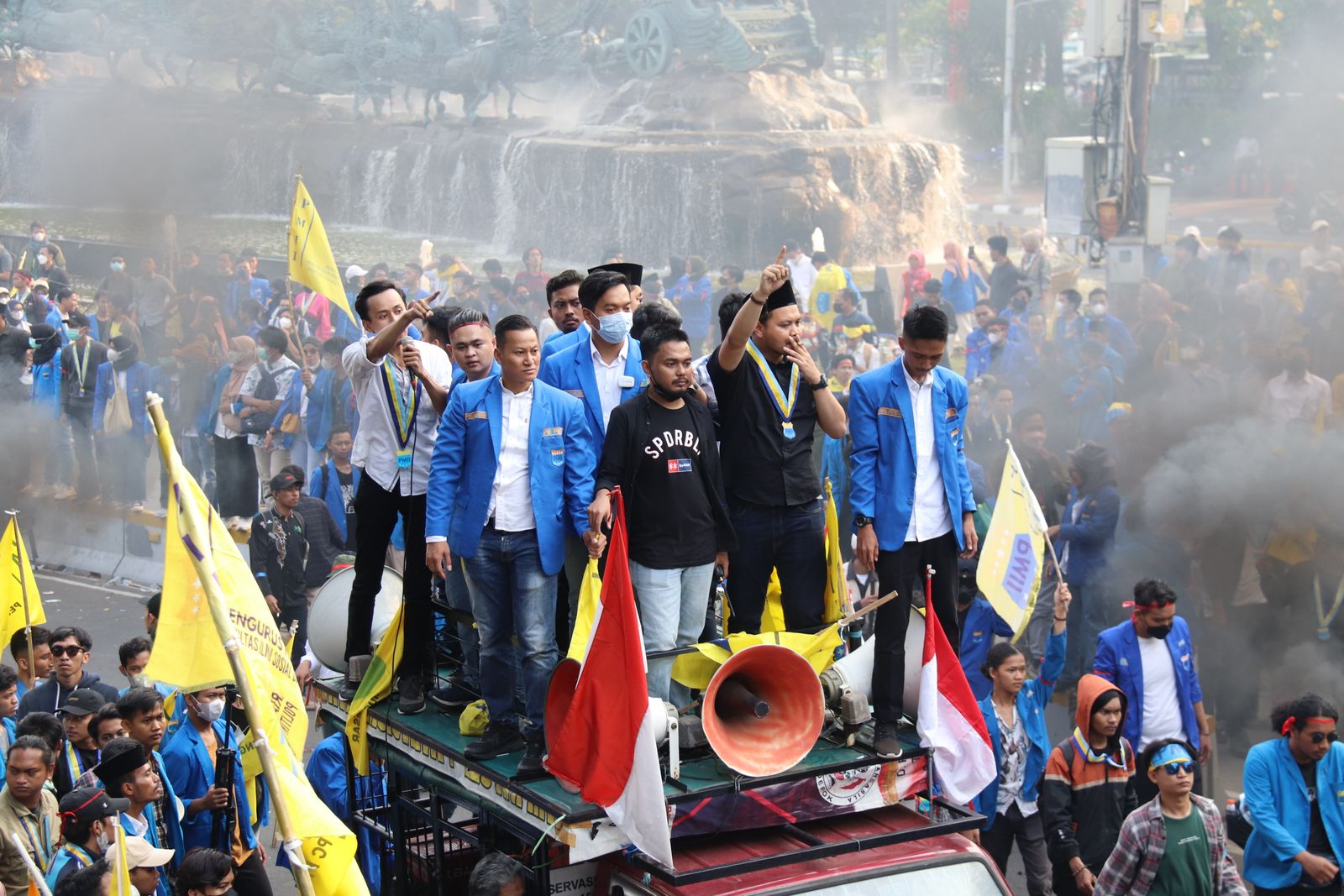
Photo: Pexels
On 21 May 1998, after 32 years in power, President Suharto announced his resignation in a short televised statement at the Merdeka Palace. Within six years, Indonesia had held free multiparty elections, amended its constitution four times, ended the military’s guaranteed seats in parliament, devolved substantial power to the regions, created a Constitutional Court and, in 2004, held its first direct presidential election. Few countries have changed their political institutions so much, so quickly, with so little bloodshed at the centre.
Reformasi is therefore an important test for theories of democratic transition. This essay outlines how the major frameworks explain it, and where each falls short.
How the New Order ended
Three factors combined. First, the Asian financial crisis that began in mid-1997 caused the rupiah to lose most of its value and the economy to contract by around 13 percent in 1998. That destroyed the New Order’s main source of legitimacy, economic growth. Second, student protests grew from campus demonstrations into a national movement. The shooting of four students at Trisakti University on 12 May 1998 and the riots in Jakarta and other cities on 13–15 May, which included targeted violence against Chinese Indonesians, made the crisis acute. Third, the regime’s elite coalition broke apart. Parliamentary speaker Harmoko called on Suharto to resign, fourteen ministers refused to serve in a reshuffled cabinet, and the armed forces commander, General Wiranto, did not use force to keep Suharto in power.
The “transitology” framework
Guillermo O’Donnell and Philippe Schmitter’s Transitions from Authoritarian Rule: Tentative Conclusions about Uncertain Democracies (1986) argued that transitions begin with splits within the authoritarian regime, between “hardliners” and “softliners”, and proceed through negotiation and pacts between softliners and moderate opposition leaders. Mass mobilisation matters, but mainly as pressure that strengthens the softliners.
Indonesia fits this model partly. Suharto’s fall did follow a split in the elite. His successor, B. J. Habibie, was a regime insider who chose rapid liberalisation, freeing the press, releasing political prisoners, allowing new parties and holding early elections in June 1999, rather than repression. Edward Aspinall’s Opposing Suharto (2005) shows how the New Order’s long tolerance of a limited “semi-opposition” shaped the transition, producing moderate opposition leaders such as Megawati Sukarnoputri, Abdurrahman Wahid and Amien Rais who were willing to work within the system.
But there was no formal pact. Unlike Spain’s Moncloa Pacts or Chile’s negotiated transition, Indonesia’s democratisation proceeded through a series of incremental bargains within existing institutions, especially the MPR.
Constitutional reform from within
Donald Horowitz’s Constitutional Change and Democracy in Indonesia (2013) highlights one unusual feature. Indonesia did not draft a new constitution. Instead, the MPR amended the 1945 Constitution four times between 1999 and 2002. Horowitz argues that this insider-led, incremental process, in which existing parties bargained with each other without a constitutional convention or the influence of foreign advisers, was more successful than its critics expected. It produced reforms that reduced the risk of conflict: direct presidential elections with a requirement for wide geographic support, a regional chamber (DPD), and rules discouraging regional parties, apart from a special arrangement for Aceh after 2005.
Linz and Stepan: consolidation
Juan Linz and Alfred Stepan (1996) defined a consolidated democracy as one where democracy is “the only game in town” in behaviour, attitudes and constitutional practice, and they identified five arenas that must be strengthened: civil society, political society, rule of law, the state bureaucracy and economic society. Indonesia made notable progress in civil society and political society. Its record on rule of law and bureaucratic reform has been weaker, as shown by corruption, uneven law enforcement and the military’s continued influence in internal security.
The oligarchy critique
The most influential challenge to optimistic readings is the oligarchy thesis. Richard Robison and Vedi Hadiz, in Reorganising Power in Indonesia (2004), argued that the New Order’s politico-business elites were not removed by Reformasi. They reorganised themselves, taking over parties, parliaments and regional governments through money politics. Jeffrey Winters’ Oligarchy (2011) made a related argument: extreme concentration of wealth gives a small group the means to defend their interests under any regime type, so that democracy has changed how oligarchs compete without ending their power.
Critics such as Marcus Mietzner reply that this approach underestimates the real autonomy of voters, civil society and reformers, and cannot explain reforms that oligarchs opposed. This “pluralist versus oligarchic” debate remains one of the most productive in Indonesian studies.
From consolidation to regression?
Since around 2016, much scholarship has examined democratic regression. Thomas Power and Eve Warburton’s edited volume (2020) documents declining protections for civil liberties, the weakening of the Corruption Eradication Commission (KPK) through 2019 legislation, the use of legal and security institutions against opponents, and the 2023 Constitutional Court ruling that allowed Gibran Rakabuming Raka to stand for vice president. Whether this amounts to a reversal of Reformasi or a lasting “hybrid” equilibrium is now the central question for research on Indonesian politics.
Questions for seminar discussion
- Did Indonesia’s transition happen because of elite divisions or because of mass protest? How would you test the difference?
- Is Horowitz right that insider-led constitutional amendment produced better outcomes than a fresh constitution would have?
- Does the oligarchy thesis leave room for meaningful democratic change? What evidence would falsify it?
References and further reading
- Aspinall, E. (2005). Opposing Suharto: Compromise, Resistance, and Regime Change in Indonesia. Stanford University Press.
- Aspinall, E., & Mietzner, M. (Eds.). (2010). Problems of Democratisation in Indonesia: Elections, Institutions and Society. ISEAS.
- Horowitz, D. L. (2013). Constitutional Change and Democracy in Indonesia. Cambridge University Press.
- Linz, J. J., & Stepan, A. (1996). Problems of Democratic Transition and Consolidation: Southern Europe, South America, and Post-Communist Europe. Johns Hopkins University Press.
- Mietzner, M. (2009). Military Politics, Islam, and the State in Indonesia: From Turbulent Transition to Democratic Consolidation. ISEAS.
- O’Donnell, G., & Schmitter, P. C. (1986). Transitions from Authoritarian Rule: Tentative Conclusions about Uncertain Democracies. Johns Hopkins University Press.
- Power, T., & Warburton, E. (Eds.). (2020). Democracy in Indonesia: From Stagnation to Regression? ISEAS–Yusof Ishak Institute.
- Robison, R., & Hadiz, V. R. (2004). Reorganising Power in Indonesia: The Politics of Oligarchy in an Age of Markets. RoutledgeCurzon.
- Winters, J. A. (2011). Oligarchy. Cambridge University Press.